 Skip to content




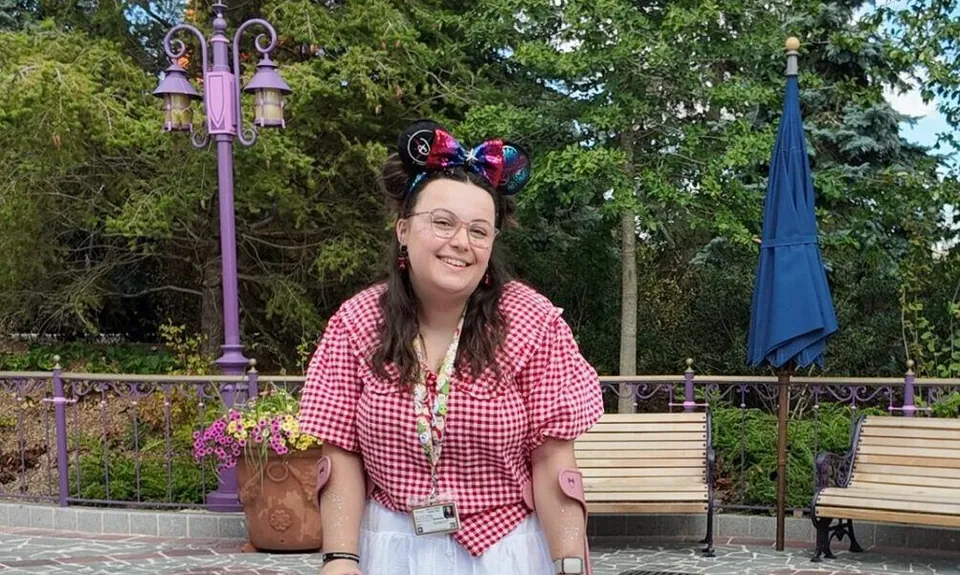
I’ve now used the Disneyland Paris Priority Card across two separate trips, first in June 2025 and again in August 2026, and I can confidently say that I don’t think I’d be able to experience Disneyland Paris in the way that I do without it.
Planning your whole trip? Read my Disneyland Paris Accessibility as a Disabled Visitor: What I Wish I’d Known Before I Went guide for my wider experience of rides, hotels, transport, crowds, packing and doing Disney with a wheelchair.
I know that sounds dramatic, especially when the Priority Card is sometimes spoken about online as though it’s simply a way for disabled people to “skip the queues”, but for me it couldn’t be further from that. Disneyland is already a physically demanding place to spend a day, before you add in chronic illness, mobility aids, medication, fatigue, sensory overwhelm and thousands of very excited people all trying to navigate the same magical world at once.
What the Priority Card gives me is the ability to remove some of those unnecessary barriers. If I don’t have to use an hour of my limited energy sitting in a tightly packed queue, that’s an hour of energy I might instead be able to spend exploring the park, watching a parade, meeting a character or frankly just wandering around a Disney shop looking at sparkly things.
After using the system twice, I’ve also realised that there’s much more to the Priority Card than rides. I’ve used it in shops, restaurants and viewing areas, learnt when I need to actually speak up and show it rather than politely waiting to be noticed, and discovered a few little tricks that make using it considerably easier.
So, this isn’t a guide to getting more rides out of your Disney day. It’s everything I’ve learnt about using the Disneyland Paris Priority Card to make the parks work better with my disabilities.
As always, this is my experience as an ambulatory wheelchair user with multiple disabilities, rather than a promise of what somebody else’s access will look like. Disneyland Paris can also change its procedures, eligibility criteria and access arrangements, so I’ve linked the current official information throughout. The official information referenced in this article was checked in November 2026, but please check it again before you travel.
What is the Disneyland Paris Priority Card?
The Disneyland Paris Priority Card is an accessibility provision for guests with an officially recognised disability who can provide one of Disneyland Paris’ accepted forms of disability evidence.
Disney currently describes the card as providing priority, but not immediate, access to attractions, theatres, outdoor shows, parades, Character Encounters and payment counters in restaurants and shops. You can find the current information on the official Disneyland Paris accessibility page.
I think the “not immediate” part is important because the Priority Card is sometimes incorrectly described as a “queue-skipping pass”.
In my personal experience, I’ve certainly had occasions where a conventional queue of an hour or more has effectively become a wait of only a few minutes, but that’s my experience rather than something the card guarantees.
The point of the adjustment isn’t to help disabled guests squeeze more rides into a day than everyone else. It’s there to remove or reduce some of the barriers that conventional queueing can create.
For me, as someone living with multiple disabilities, that difference is part of what makes a Disney park day possible in the first place.

Why I use a Priority Card
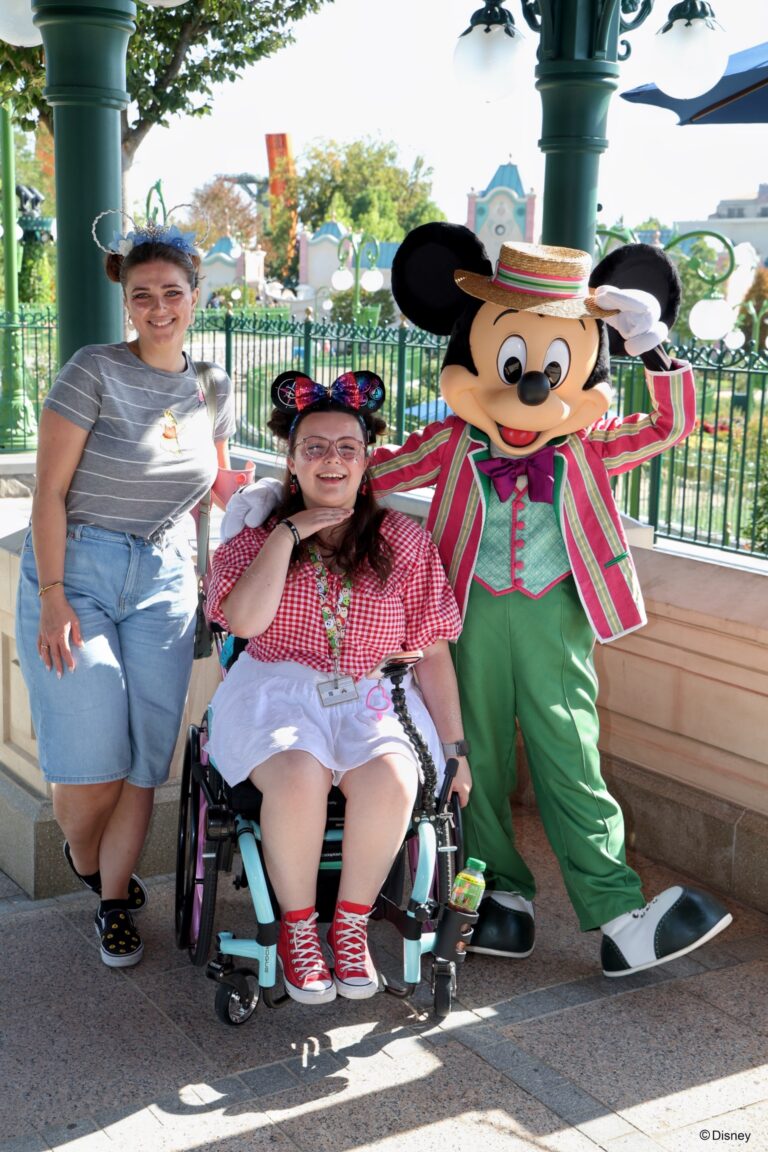
I use a wheelchair and have a stoma, although I’m ambulatory and can walk and transfer short distances when necessary. I also live with various chronic illnesses which affect things like my energy, pain, medication requirements and how long I can comfortably remain in certain situations.
Sitting in a queue for an hour isn’t simply an inconvenience for me. It would potentially use a significant portion of the energy I’ve got available for that day, and being trapped within a tightly packed queue can also introduce a whole range of other physical and sensory challenges.
This is on top of navigating Disneyland Paris in general with a mobility aid. The parks themselves offer accessibility incredibly well, but other visitors have a slightly more creative interpretation of spatial awareness and quickly end up walking into you!
Being able to remove an unnecessary hour standing or sitting in a winding queue can be the difference between having enough energy to enjoy the rest of the day and Disney being a complete impossibility, and this is a common feeling across the chronic illness community.
That’s why, when I see people describing the Priority Card as a “skip the queue card”, I think it completely misses the point. It’s creating a way for people with disabilities to be able to access the parks.
Applying for the Disneyland Paris Priority Card
Disneyland Paris has done brilliantly in making the application surprisingly straightforward and having spent considerable portions of my disabled life dealing with things like PIP paperwork, I don’t say that lightly.
You can currently apply for your Disneyland Paris Priority Card online or from within the app up to one month before your visit. Disney asks you questions about your level of autonomy because this information is used to establish the appropriate access conditions and, importantly, how you could be evacuated safely from attractions if something went wrong.
You’ll need to provide your contact information and a suitable photograph as part of the online process.
On arrival, Disney currently requires you to present an original copy of accepted proof of disability for your country plus photo ID before the Priority Card is issued, so don’t make the mistake of completing the online application and assuming that’s the end of the process.
Disney maintains a country-specific list of accepted evidence as part of its Priority Card application, so check the requirements that apply to you before travelling. In my case I used an access card and my PIP award letter, but I check each time I go if this is still accepted.
You can find the latest application process and eligibility information on the official Disneyland Paris Priority Card page.
Be completely honest about your mobility
This is one thing I would particularly stress. When I completed my own application for my second trip, I made it clear that although I use a wheelchair, I’m ambulatory and can generally transfer onto attractions.
Some Disneyland Paris attractions can be accessed in a wheelchair, while others require you to transfer from your wheelchair into the ride vehicle. Disney also uses different evacuation requirements depending on the attraction and your level of mobility. Disney has more information about this within its accessibility guidance for attractions.
Collecting your Priority Card
Once you’ve applied online, you’ll receive confirmation and can collect your Priority Card when you arrive.
Disney currently says cards can be collected at Disney Hotels or at dedicated locations at the entrance to the Parks, provided you present your file number, accepted disability evidence and proof of identity. According to Disney’s current Priority Card information, an individual card requested for a visit is valid for six days.
If you’re lucky enough to have a Disneyland Pass, the arrangements are slightly different. Disney currently advises Pass holders to request their Priority Card at the Disneyland Pass Office, which allows the card to have the same validity period as the Pass. Again, I’d check the current Priority Card arrangements before travelling.
Overall, I find this process super easy and if I do have any questions, I know I can ask a cast member who’s happy to help or point me in the direction of someone who can.
Tip: Put your Priority Card on a lanyard
This may be the least glamorous Disneyland Paris advice I ever give you, but honestly, just take (or buy) a lanyard. You’ll be pulling out your priority card repeatedly throughout your park days, and having it close to hand makes it so much easier and harder to lose it!
It’s such a tiny adaptation, but sometimes those are the things that make a surprisingly big difference.
How I actually used the Priority Card on rides
The specific route you take varies between attractions, and your access conditions will depend on your individual requirements and the attraction itself, which is why I’d always recommend checking Disney’s official attraction accessibility information alongside lived-experience reviews like mine.
In my experience, I would generally approach the attraction and show a Cast Member my Priority Card. They would then tell me where I needed to go, which frequently involved entering through an exit. The cast members can also advise you of what the ride is like, so if you (like me) aren’t one for rollercoasters or high-speed, they can give you a heads up!
One of my favourite Priority Card experiences was actually Frozen Ever After, which is currently one of the newest rides in the park. The accessible route we used took us through the exit and up a long, gently increasing indoor ramp. Given that we were visiting during the summer, this also came with the unexpected luxury of several minutes in air conditioning.
By the time we reached the top, we were virtually at the ride and I don’t remember waiting more than a few minutes before being able to board during my visits. For me, that’s exactly where Priority access becomes so valuable. I hadn’t spent an hour getting increasingly hot and exhausted before even reaching the boat, so I was able to actually enjoy the experience I’d come for.
It’s a Small World was another accessibility favourite
From an accessibility perspective, I absolutely adore It’s a Small World.
There was space for me to leave my mobility equipment, the Cast Members immediately understood what was needed when I showed my Priority Card, and the boarding arrangements worked brilliantly for my particular level of mobility.
The ride is also slow, comfortable and doesn’t ask an enormous amount of me physically once I’m seated, so I get essentially the same experience as everyone else around me.
As any Disney-lover will know, it’s also one of the more sensory rides and that song lives rent-free in my brain!
Priority access doesn’t make every attraction accessible
Having a Priority Card does not mean every attraction automatically becomes suitable for you.
Some rides require transfers. Some have physical restrictions. Some require particular evacuation capabilities, and the design of individual ride vehicles can create difficulties that aren’t going to be accessible for everyone.
For example, I personally found Flying Carpets Over Agrabah considerably more awkward. The ride vehicle felt tight around my legs when sharing it with somebody else, which may be particularly relevant if you need a carer beside you and have limited mobility.
Meanwhile, my experience on Rapunzel’s Tangled Spin was fantastic because there was a ride vehicle with a larger door that gave me more room to transfer. It’s a judgment call at each ride, but for the most part you can find ways to adapt a lot of the experiences to suit.
Disney publishes accessibility information for its attractions, including information about wheelchair access and transfers.
The Priority Card is useful for much more than rides
This is something I didn’t realise until my second visit. According to Disneyland Paris’ official accessibility information, Priority Card access currently extends beyond attractions to eligible shows, parades, Character Encounters and payment counters at restaurants and shops.
The shops were somewhere I unexpectedly found it particularly useful – many are busy and relatively narrow, and conventional queues can snake around displays in a way that becomes awkward when you’re manoeuvring a wheelchair.
Using the Priority Card sometimes allowed me to access an appropriate lower till and avoid navigating the conventional queue, meaning I could get in and get myself out of everybody else’s way again which was really helpful.
Don’t wait for somebody to notice your Priority Card
A bad habit I have definitely picked up as a British person, is the need to queue. I was sometimes worried that proactively showing my Priority Card might look like I was trying to push in, so I’d join the normal queue and wait until a Cast Member noticed me and said, essentially, “No, no, come over here.”
Except Cast Members are incredibly busy and they aren’t always going to notice you. I’ve learnt that there’s nothing wrong with politely approaching somebody, showing your Priority Card and asking where you’re supposed to go. If you are able to use this, they’ll let you know and actually you’ll likely keep the walkway clearer for others in the queue.
We got to stick together – 100%
Something I’ve struggled with at some UK attractions is accessibility systems inadvertently separating me from the person supporting me. That can make an already challenging environment significantly more stressful.
At DLP, I really appreciate being able to remain with the person travelling with me through so many of our experiences.
On my most recent trip, my travelling companion had her own neurodivergent access requirements, so although she was supporting me, I was also conscious of how crowds, noise and unfamiliar situations were affecting her. Being able to move through those experiences together rather than repeatedly being split apart was incredibly valuable.
The permitted number of accompanying guests can depend on the attraction or experience and its safety requirements, so check the current Disneyland Paris accessibility information before your trip, but often you can take one or two companions on most things.
Priority viewing areas don’t mean arriving five minutes before a parade
The Priority Card can also be useful around entertainment, but this is where I’d reset your expectations slightly.
Disney provides dedicated spaces for disabled guests and accompanying guests at some outdoor shows and parades, with the current arrangements detailed in its official accessibility information.
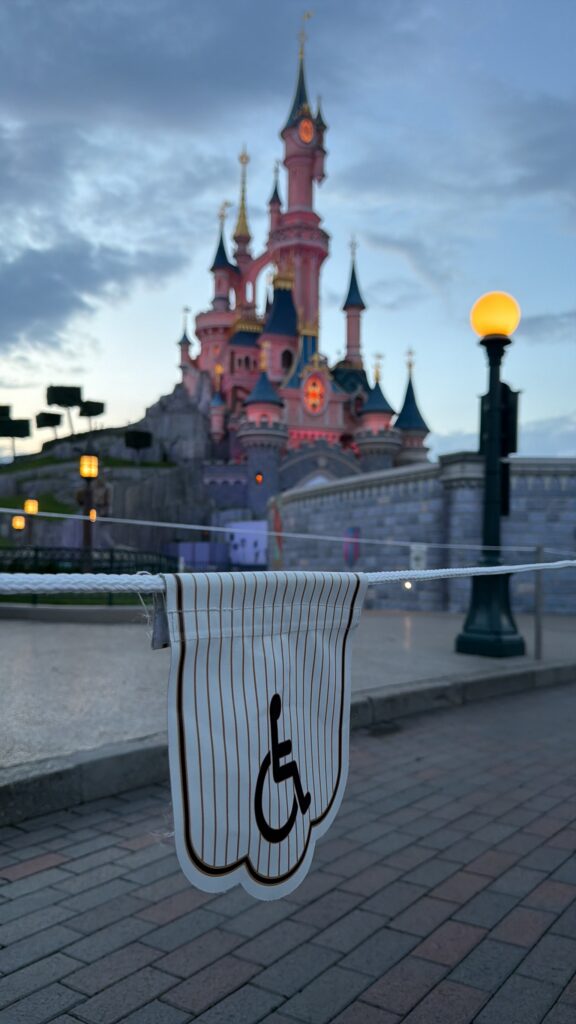
That doesn’t mean you can stroll up thirty seconds before the fireworks begin and expect the perfect unobstructed castle view to materialise. For the evening castle entertainment, we got into position around 90 minutes before it started because getting an excellent was one of the centre points of the trip for us.
We were rewarded with a brilliant position at the front of the accessible viewing section, but we had to be organised.
Parades are also one of the times I found other guests more difficult to navigate. People are understandably excited, they’re concentrating on the characters rather than what’s happening around them and once crowds form it can become extremely difficult to weave through them with a mobility aid.
If there’s a particular parade or show you desperately want to see, ask a Cast Member earlier in the day where the accessible viewing area is and when they’d advise getting there.
The Priority Card won’t remove every accessibility issue
Disneyland Paris generally impressed me tremendously with accessibility, but that doesn’t mean every accessibility experience was perfect.
I attempted to use the lift to access the upper part of Sleeping Beauty Castle during my second visit and it wasn’t available, meaning that despite having a Priority Card, that part of the experience wasn’t accessible to me at the time. That’s unfortunately the reality of access anywhere in the world.
The purpose of the card isn’t to fix every accessibility issue, but it is there to remove a significant number of barriers that don’t need to exist, and in my experience Disneyland Paris’ Cast Members were overwhelmingly willing to help me work out alternatives where they could.
What about discounted tickets for disabled guests and carers?
This is slightly separate from the Priority Card itself, but it’s worth understanding because it can make your trip significantly cheaper and go hand-in-hand.
At the time of writing, Disneyland Paris offers a 25% reduction on certain Disney Park tickets for an eligible guest with a disability and one accompanying guest, subject to Disney’s current terms and accepted proof of disability.
You can check the current offer, conditions and documentation requirements on Disney’s official tickets for Guests with disabilities page.
You can currently get a disabled guest discount on a Disneyland Pass too
I’m not an annual pass holder yet – but I’m hoping it’s going to happen for me someday soon!
At the time of writing, it looks like Disneyland Paris advertises a disabled guest discount on the Disneyland Pass, subject to its eligibility requirements and valid disability documentation. As these prices and terms can change, I’d check Disney’s official tickets and Disneyland Passes for Guests with disabilities page before buying.
For me, a Disneyland Pass would potentially make Disneyland Paris more accessible because I wouldn’t feel so much pressure to squeeze everything into three exhausting park days, knowing I could go back more often.
I’d be able to go for shorter periods, experience different seasons, spend an hour drinking peach tea on Main Street without feeling guilty about it and leave when my body had had enough because I’d know I could come back.
If you’re a Disneyland Pass holder, Disney also publishes the current Priority Card arrangements for Pass holders on its Priority Card page.
Disney, if you’re reading, call me!
My biggest Priority Card tips after using it twice
If I were going again tomorrow, these are the things I’d want another disabled visitor to know:
- Apply online before you travel. Check the current Priority Card application before your visit so you know what information and evidence you’ll need.
- Check your disability evidence. Don’t assume a document will be accepted because somebody else used it on a previous trip.
- Answer the autonomy questions honestly. They’re about finding safe access and evacuation arrangements for you.
- Wear your card on a lanyard for ease.
- Show the card proactively. Don’t wait for Cast Members to notice you.
- Ask where you’re supposed to go. Different attractions have different access routes.
- Don’t assume Priority means immediate. Sometimes my wait genuinely was only a few minutes, but Disney doesn’t guarantee that (and its worth waiting for!)
- Use it outside the rides. Shops, entertainment and Character Encounters can be exactly where conserving energy matters.
- Plan for parades. An accessible viewing section doesn’t mean you won’t need to arrive early.
- Remember that accessibility is individual. An attraction being brilliant for me doesn’t guarantee it’ll work for you.
- And perhaps most importantly, don’t feel guilty for using it.
So, is the Disneyland Paris Priority Card worth getting?
For me, unequivocally yes.
I don’t think I would be able to experience Disneyland Paris in the way I do without it.
Not because it gives me more Disney than everybody else, but because it gives me a better chance of accessing Disney with the body and energy I’ve actually got. It bridges the gap between the non-disabled experience and me. That’s the difference.
A lot of accessibility adjustments are talked about as though they’re somehow giving disabled people an advantage, when in reality they’re often simply compensating for disadvantages that already exist.
The priority card removes some of that unnecessary friction and that’s what good accessibility should do. It shouldn’t make disabled people feel as though they’re receiving something extra. It should give us a fairer opportunity to experience the magic that’s already there. Disneys got it right with this!
Useful official Disneyland Paris resources
Accessibility arrangements, accepted documentation, discounts and Priority Card procedures can change, so I’d always check the official information shortly before travelling:
- Apply for a Disneyland Paris Priority Card
- Disneyland Paris accessibility information
- Disneyland Paris tickets and Passes for Guests with disabilities
- Disneyland Paris attraction accessibility information
Read next: Disneyland Paris Accessibility as a Disabled Visitor: What I Wish I’d Known Before I Went
Still preparing for your trip? Read my Disneyland Paris packing list for disabled travellers for everything I take into the parks alongside my Priority Card.



[…] to know exactly how the system works? I’ve written a full Disneyland Paris Priority Card guide based on using it across two separate trips, including applying, rides, shops, viewing areas and […]
[…] use Disney’s accessibility provisions, I’ve also written about my experience using the Disneyland Paris Priority Card across two […]