 Skip to content
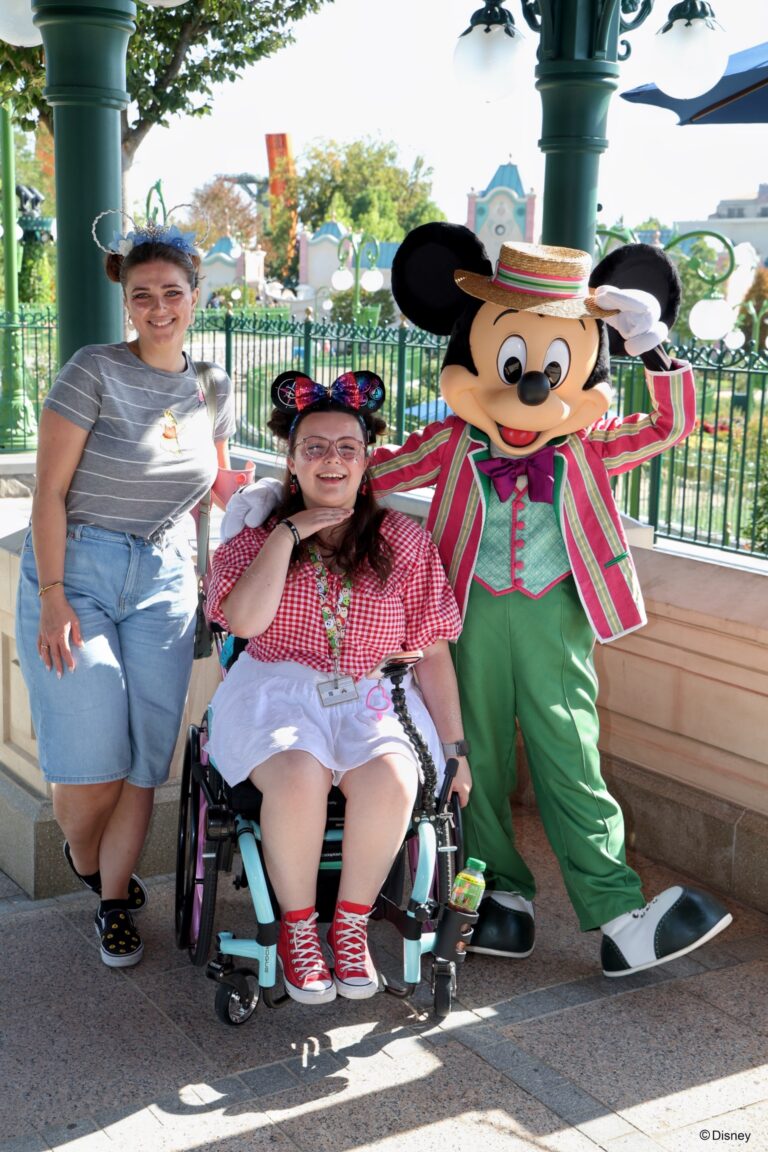
I’ve now been to Disneyland Paris twice as a disabled adult, once in June 2025 and again in August 2026, spending three days in the parks on both trips and using a Priority Card each time. You’d think that would mean I’d pretty much completed Disney by now, but absolutely not. If anything, I’ve come home the second time with an even longer list of things I want to go back and do and my next plan is to work out when I go back!
Both trips taught me completely different things about doing Disneyland Paris with disabilities, a wheelchair, a stoma, chronic illness and a body that unfortunately doesn’t seem to understand that Disney excitement should temporarily override all medical conditions.
The first time I travelled with somebody who knew Disneyland Paris incredibly well (that being the incredible Lauren from Access Your Life), which was a huge advantage because she knew where we were going, how things worked and where the accessible entrances were. The second time I had to figure much more of it out myself, and although I felt significantly more confident, I still got things wrong.
I’ve learnt how to use the Priority Card properly now, along with how to navigate the parks in a wheelchair, how summer weather affects my body and mobility equipment, and perhaps most importantly, that you don’t need to complete Disneyland Paris to have had a brilliant Disney holiday.
So, if you’re disabled and planning a DLP trip, these are all the things I wish I’d known before I first went. This isn’t intended to be a definitive Disneyland Paris accessibility guide, because no two disabled visitors have exactly the same access requirements, but rather my experience of navigating Disneyland Paris as an ambulatory wheelchair user after two visits.
If you’re at the very beginning of your planning, I also recommend having the official Disneyland Paris accessibility information open alongside articles like this one, as Disney’s page contains the current information on access cards, accessible facilities, attractions, shows and other services for disabled guests.
Three days at Disneyland Paris isn’t actually that long
On both of my trips, I had three days with tickets that allowed me to visit both parks. Three days sounds like loads of time until you actually arrive and realise quite how much there is to do.
After not making it the whole way around during my first trip, I became slightly laser-focused on seeing as much as humanly possible the second time. I rushed more than I probably should have and tried to cram things in because I had this feeling that I needed to get my money’s worth and experience everything while I had the opportunity.
I’m glad we pushed ourselves to see some of it because we discovered some amazing things that I didn’t know were there, but I also wouldn’t necessarily recommend doing Disney that way.
When you’re disabled, you’ve often already spent an obnoxious amount of time, money and energy just arranging to get somewhere. You’ve booked assistance, thought about medication, researched accessibility, checked transport, prepared mobility equipment and packed half a pharmacy into your suitcase, so when you finally arrive there’s a very understandable temptation to think, right, now I have to make every second count.
Except sometimes making every second count means exhausting yourself so much that you stop enjoying the seconds.
Three days is enough to have an amazing time, but in my opinion it isn’t enough to experience both parks slowly, particularly as Disneyland Paris continues to expand. If you’re going once and don’t expect to return for years, your priorities may understandably be different, but after two visits I’ve realised I’d happily go for a third, fourth and fifth and still find something new.
Read more: My accessible Disneyland Paris adventure – Day-by-Day
You don’t have to be doing something all the time
One of the biggest things I think people misunderstand before a first trip is that being at Disney is part of the attraction. You don’t need to be on a ride every minute of the day.
Some of my favourite moments have been wandering around the shops, looking at the seasonal decorations, sitting somewhere beautiful with a drink, taking photos, people-watching and generally soaking up the fact that I’m there. You’re at Disney, for goodness’ sake – that’s an achievement!
Especially as a disabled person, I think there’s enormous value in deliberately planning some time that isn’t planned. It’s ok to let yourself sit somewhere, soak in the feelings of the crowd before they disappear, find somewhere shady and have a drink. Take twenty minutes to stare at the castle and take photos because you can! That, to me, is truly experiencing Disney.
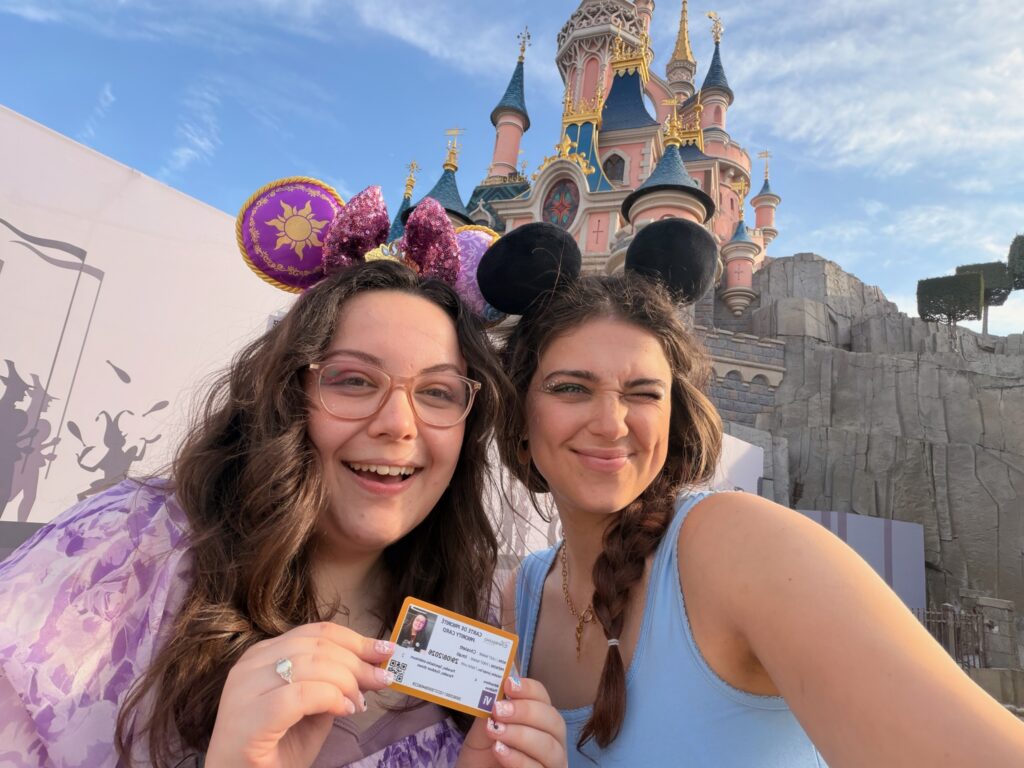
Apply for your Disneyland Paris Priority Card before you go
Applying for the Priority Card is incredibly straightforward, which in a world of PIP claims and the DWP is really nice.
At the time of writing, you can apply for a Disneyland Paris Priority Card online up to one month before your visit. Disney asks questions about your level of autonomy so that it can determine the appropriate access and evacuation arrangements, and you’ll need to present an original accepted proof of disability and photo ID when collecting the card.
Disney maintains a country-specific list of accepted disability documents, so I strongly recommend checking the current Priority Card requirements before travelling rather than assuming a particular document will automatically be accepted. I used my PIP letter in this instance.
When completing the application, answer the questions honestly about what you can and can’t physically do because those answers are important in determining how you’re able to access attractions safely. I’m ambulatory and can generally transfer onto rides, so I made that clear when completing mine.
Disney also publishes broader accessibility information for disabled guests, including information about attraction access, shows, Character Encounters, toilets, First Aid, wheelchair rental and other services.
The Priority Card isn’t a “skip the queue pass”
This is probably one of the biggest misconceptions around the Disneyland Paris Priority Card.
Disney officially describes its Priority Card as providing priority, but not immediate, access to eligible attractions, shows, parades, Character Encounters and payment counters in restaurants and shops. You can read Disney’s current explanation on its accessibility page.
In practice, there were plenty of occasions during my visits when an hour-long conventional queue translated into only a few minutes for me, but I don’t see the card as something that lets me “beat” everybody else to a ride. I see it as something that helps me conserve enough energy to actually have a park day.
Standing for long periods, queueing, navigating huge crowds and constantly manoeuvring a mobility aid around other people can be overwhelming for anybody, let alone when you’re already starting with limited energy, medication requirements and disabilities. Removing some of those barriers means I can use the energy I do have on the things I’ve actually travelled to Disneyland Paris to enjoy.
For me, the Priority Card isn’t about doing Disney faster. It’s about making Disney manageable. I wouldn’t be able to manage it without it, speaking plainly.
Disabled guests can currently qualify for discounted tickets
This is another important thing to know when budgeting for your trip.
At the time of writing, Disneyland Paris offers a 25% reduction on certain Disney Park tickets for an eligible disabled guest and one accompanying guest, subject to its current terms and accepted proof of disability.
You can check the current discounts, documentation requirements and ticket conditions on Disney’s official special-rate tickets for Guests with disabilities page.
I think the companion discount is particularly important because “take someone with you” is very easy advice to give a disabled person, but having another person accompanying you potentially means another ticket, another journey and additional costs. In my case, I wouldn’t have been able to do this trip completely independently, so recognising the financial reality of travelling with somebody else matters.
Don’t be afraid to actually use the adjustments you’re entitled to
This sounds ridiculous given I’d gone through the process of applying for a Priority Card, but sometimes my British instinct to politely queue and avoid looking like I’m pushing in took over.
In some of the shops I wasn’t always sure when I was supposed to show the card, so I’d occasionally join the conventional queue until a Cast Member noticed me and called me over to the appropriate till.
The lesson I learnt was that you sometimes have to politely advocate for yourself rather than waiting to be noticed. Cast Members are managing thousands of guests and aren’t necessarily going to spot your card or mobility aid immediately, so if you know an accessibility arrangement exists, ask.
In the shops this was genuinely useful because some are quite narrow and navigating a wheelchair through a winding queue could leave me feeling as though I was in everybody else’s way. Having access to a lower till and, where appropriate, priority access meant I could get what I needed, pay and get out of the busiest areas much more comfortably.
Disney states that its restaurants and shops are wheelchair accessible, while its Priority Card can provide priority access at eligible payment counters. You can check the current Disneyland Paris accessibility facilities before travelling.
Restaurants also had more accessible areas and lower surfaces available in my experience, and generally I found that once Cast Members understood what I needed, they were brilliant at finding ways to help.
Put your Priority Card on a lanyard
Honestly, just do it. You’re going to show your Priority Card repeatedly throughout the day, and having it buried inside a handbag or wheelchair pouch means constantly getting it back out again.
I wore mine on a lanyard, which meant Cast Members could see it easily and I always knew exactly where it was. If you’re using Disney PhotoPass, you can keep that there too, which means when a photographer needs the barcode you’re not rummaging around looking for it.
It’s an incredibly boring tip until you’ve shown the card for the fiftieth time and then you’ll thank me.
Some attractions were particularly brilliant with accessibility
Not everything at Disneyland Paris can be accessible to every disabled person, because disability simply isn’t universal, but I’ve been pleasantly surprised across both visits by how many options Disney provides to allow people to participate in different ways.
Disney itself explains that some attractions have specially adapted vehicles and equipment, while others require guests to transfer from their wheelchair. I’d recommend looking at the official Disneyland Paris information on attractions for Guests with disabilities alongside your own research before deciding what’s suitable for you.
One of my favourite attractions from an accessibility perspective is It’s a Small World. There’s a large area to leave mobility equipment, the Cast Members were fantastic with my Priority Card, there are accessible boarding arrangements and the ride itself is slower-paced, comfortable and wonderfully sensory without asking much of me physically. I can sit there, enjoy it and have my friends around me experiencing the same thing. It tickles me every single time and THAT song will never leave my brain.
Rapunzel’s Tangled Spin was another favourite. One of the ride vehicles has a much larger door, giving people with mobility difficulties more space to transfer in and out, and when I visited there was a clear place for disabled guests to wait and leave mobility equipment nearby. It’s also absolutely beautiful.
Then there’s Frozen Ever After, where my Priority Card route took me up the exit through a long, gently rising corridor. We visited in summer, so walking through a wonderfully cool indoor corridor rather than standing outside in the heat felt like a luxury in itself. At the top, we were essentially at the attraction and I don’t remember ever waiting more than a few minutes before boarding.
The boat requires me to transfer down into it, so it won’t work for everyone, but for my level of mobility it worked incredibly well.
Always check the accessibility information for the individual attraction because your Priority Card does not automatically mean every attraction will be suitable for your particular mobility or evacuation requirements.
Older Disney rides can present different challenges
Some of the older attractions naturally felt more challenging than newer ones.
Flying Carpets Over Agrabah, for example, felt physically tight around my legs when sharing the ride vehicle with someone else. Someone who needs their carer alongside them may therefore find that considerably more awkward, particularly if they also have limited motor function and need help operating the ride.
That doesn’t mean Disney has done something terrible. The parks contain attractions from different eras and not everything can simply become brand new overnight, but it’s worth remembering that your access experience may vary significantly between attractions.
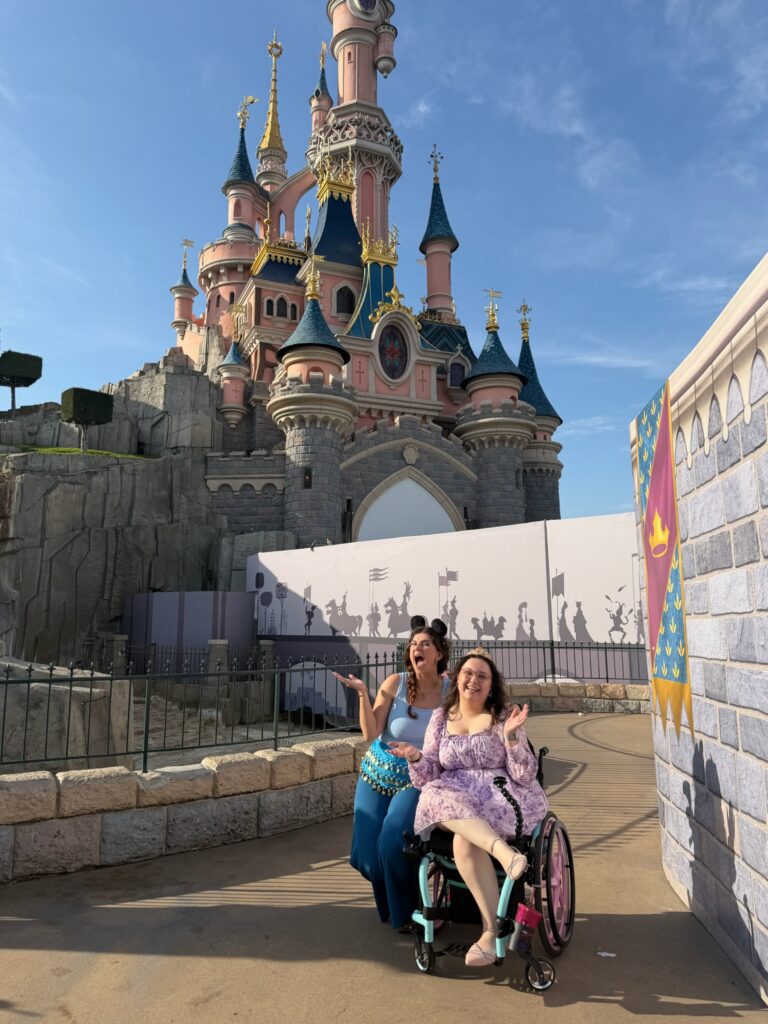
I was also gutted that the lift allowing access to the upper levels of Sleeping Beauty Castle wasn’t working when I attempted to use it during my visit. Refurbishments and technical problems obviously happen, but it did mean I couldn’t experience that part of the castle. I later discovered that I could separately access the dragon underneath, although I didn’t initially find the signage particularly obvious.
Accessibility at Disneyland Paris was overwhelmingly positive for me, but positive accessibility doesn’t mean pretending individual barriers don’t happen.
Disney recommends checking the limitations and access arrangements for individual attractions, and its accessibility information for Guests with disabilities is a sensible place to start.
Your mobility aid needs its own Disney packing list
This wasn’t something I’d properly considered before going – but I guess it’s a mistake you only make once!
During the hotter weather I found the batteries on my mobility equipment could drain more quickly than I expected, so having access to power became important. On my visit I was allowed to charge my mobility equipment while at Frozen’s Regal View Restaurant, although I’d always ask a Cast Member rather than assuming charging will be available in any particular location.
If you’re travelling from the UK, don’t forget the appropriate EU plug adaptors for anything you’ll need to charge.
I also discovered another very glamorous wheelchair-user summer problem: if you leave a black wheelchair seat sitting in the French sunshine while you’re on a ride, you may return to what is effectively a cooking surface.
Nothing was damaged, but from a sensory perspective it wasn’t exactly delightful. I’d probably put a light towel or cover over my seat next time.
A few things attached to my wheelchair ended up being absolute game-changers. My Lapstacker gave me a way to hold things on my lap, I had a pouch underneath the chair where random purchases accumulated throughout the day, and my flexible phone holder meant I could keep the Disneyland Paris app and map directly in front of me rather than constantly stopping and getting my phone out. That meant I could see wait times, access the map and deal with virtual Character Encounter queues while moving around the park. I looked like a Disney Pro!
Summer Disney requires a little extra planning when you’re disabled
Both of my Disneyland Paris trips have been during summer, so I’m not going to pretend I can give you authoritative advice on visiting in December yet. Disney, if you’re reading, I’m waiting for my invitation.
In the heat, hydration was probably the biggest ongoing consideration for me. With adrenal insufficiency and a stoma, keeping fluids and electrolytes up matters, so I was regularly drinking electrolytes and peach tea and trying to remember the very basic human requirements of eating and drinking despite being distracted by Disney.
Unfortunately, remembering to look after one’s actual body is considerably less exciting than meeting a princess.
My stoma itself coped much better on my second trip. The first time I visited, I had more issues with appliance adhesion and leaks because I simply wasn’t accustomed to how my products and body responded in hotter conditions. By my second Disneyland Paris visit, I’d learnt considerably more about managing my stoma in heat and had a much easier experience.
Carbonated drinks can also cause my bag to inflate with gas, which reduces my drinks options somewhat when I’m already trying to stay hydrated, so next time I’d bring a greater variety of suitable drinks with me rather than relying quite so heavily on what I could find inside the parks but this can be difficult when travelling by train.
Disney does have plenty of shady areas in my experience, and indoor attractions became excellent strategic cooling breaks. Frozen Ever After and It’s a Small World both gave me a welcome opportunity to get out of the summer heat without feeling as though I was “wasting time” resting.
Pack extra medical supplies, but don’t pack an entire entertainment centre
I don’t think I’ll ever leave the country without overpacking medication and stoma supplies, and honestly I’m not interested in changing that. I’d rather bring unused medical supplies home than discover I need something in another country and don’t have it.
Where I definitely overpacked was entertainment for the hotel.
I took things thinking perhaps I’d sit completing a scrapbook or doing lovely evening activities after Disney and reader, I did not. By the time we arrived back at the hotel I was absolutely cream-crackered. I managed to go swimming once, but generally I wanted my pyjamas, something comforting, girls’ night energy and bed.
Next time I’d prioritise self-care things instead: fluffy socks, comfortable pyjamas, skincare, maybe a face mask, my iPad, something easy to read and a few reliable snacks.
Oh, and tea bags. They are vital.
Take British tea bags.
British tea is superior to French tea and I’m simply not accepting correspondence on this matter. I’m sorry France, you do many things incredibly – but I need my Tetley.
Bring a power bank
If you’re using the Disneyland Paris app, taking photos, filming videos, checking virtual queues and generally enjoying being somewhere extremely photogenic, your phone battery is going to take a battering.
Take a decent power bank and keep your charging cable easily accessible. This was particularly useful for me because I had my phone mounted to my wheelchair throughout the day, effectively turning it into my Disney sat-nav.
Take food and drinks if your dietary requirements are complicated
My dietary requirements are annoying enough in England because I’m allergic to rapeseed oil and bananas, neither of which is one of the main allergens people typically cater around. Disneyland Paris therefore required some research.
I’ve previously travelled with somebody who was gluten-free and another person with complex allergies and, in my experience, we have generally managed to find something, although options can be limited depending on the allergy.
This time I discovered the hot dog restaurant on Main Street and it became a mainstay because I’d established there were things I could eat and, importantly, they were delicious.
I didn’t personally find allergen information particularly easy to navigate for my specific allergy, although that’s also true in the UK because rapeseed oil falls outside the main allergen groups. Cast Members were generally willing to answer questions, but language differences can sometimes make complex dietary conversations more difficult.
My advice would be to research your specific dietary requirements before travelling rather than searching for generic “allergy-friendly Disney” advice.
If you’re gluten-free, search specifically for recent gluten-free Disneyland Paris experiences. If you’re dairy-free, look for other dairy-free visitors. People who actually live with your dietary requirements will usually notice things that a general guide won’t.
I’d also check the official Disneyland Paris accessibility and guest-services information close to your visit, and contact Disney directly if you need certainty around a specific medical or dietary requirement.
Don’t underestimate the shopping
I had absolutely no idea how much shopping there was during my first trip. Huge mistake.
The second time I went better prepared financially, which meant I could actually enjoy browsing.
Not everything at Disney is cheap, obviously, but I’m often pleasantly surprised by how many reasonably priced souvenirs exist alongside the expensive collectibles. There are plenty of things that feel like proper Disney merchandise without being pointless tat.
Stock is seasonal, though. Despite visiting in August and finding some Christmas merchandise already appearing, there weren’t loads of blankets and cosy products because, unsurprisingly, it was summer. You can see what I did get though here.
If you’ve seen a particular seasonal item online and have your heart set on it, don’t assume it’ll be available year-round.
Staying off-site can actually be really lovely
Both of my trips have involved staying outside the Disney resort itself and, financially, it makes an enormous amount of sense for me.
I’ve never stayed at an official Disney Hotel and would absolutely adore to experience one, partly because I’d love to compare the accessibility and overall experience for Mali & Me, but so far it simply hasn’t fallen within my budget. There are advantages to being away from Disney too.
After an entire day of excitement, dopamine, music, crowds and Disney Magic, travelling back to somewhere slightly calmer can provide a useful transition. You’re still surrounded by people who’ve largely spent their day doing the same thing, but you’re able to come down from the stimulation, eat, swim, put your pyjamas on and attempt to convince yourself that tonight will definitely be the night you get an early bedtime. Hint – It won’t be.
But “accessible hotel” doesn’t tell you enough
If there’s one thing I’d urge other disabled travellers to do, it’s investigate exactly what a hotel means when it advertises itself as accessible.
“Accessible” isn’t one universal specification because our requirements vary enormously.
Ask the questions that relate specifically to your body and mobility.
Does the bathroom have the equipment you need? Is there a shower chair? Can you physically use the bed configuration if you’re travelling with a carer? What’s the flooring like for wheelchairs? How do you get from the hotel to Disneyland Paris? If there’s a shuttle, how does a wheelchair board? How many wheelchair users can it accommodate? What happens during peak periods after the fireworks? What are the emergency evacuation arrangements?
Don’t assume that because something is described as accessible, it automatically contains the particular adaptations you require.
If possible, find disabled travellers who’ve already stayed there and look at photos and videos rather than relying exclusively on a facilities list.
Disney publishes separate information about accessibility at its own hotels within its wider Disneyland Paris accessibility guidance, so if you’re considering comparing an official Disney Hotel with an off-site property, that’s a useful starting point.
I have a separate accessibility review coming about the hotel from my most recent Disneyland Paris trip. I’ve been speaking directly with the hotel about some of the accessibility issues we encountered and they’ve been reviewing improvements, so I’m deliberately waiting until that process concludes before publishing my final assessment.
Transport is part of the Disney accessibility experience
Sometimes the hardest part of an accessible day out isn’t actually the thing you’re visiting.
It’s getting there.
I’m planning to write separately about this because travelling between the UK and Disneyland Paris, plus travelling between accommodation and the parks, really reinforced for me how quickly accessibility can unravel when different transport systems need to work together.
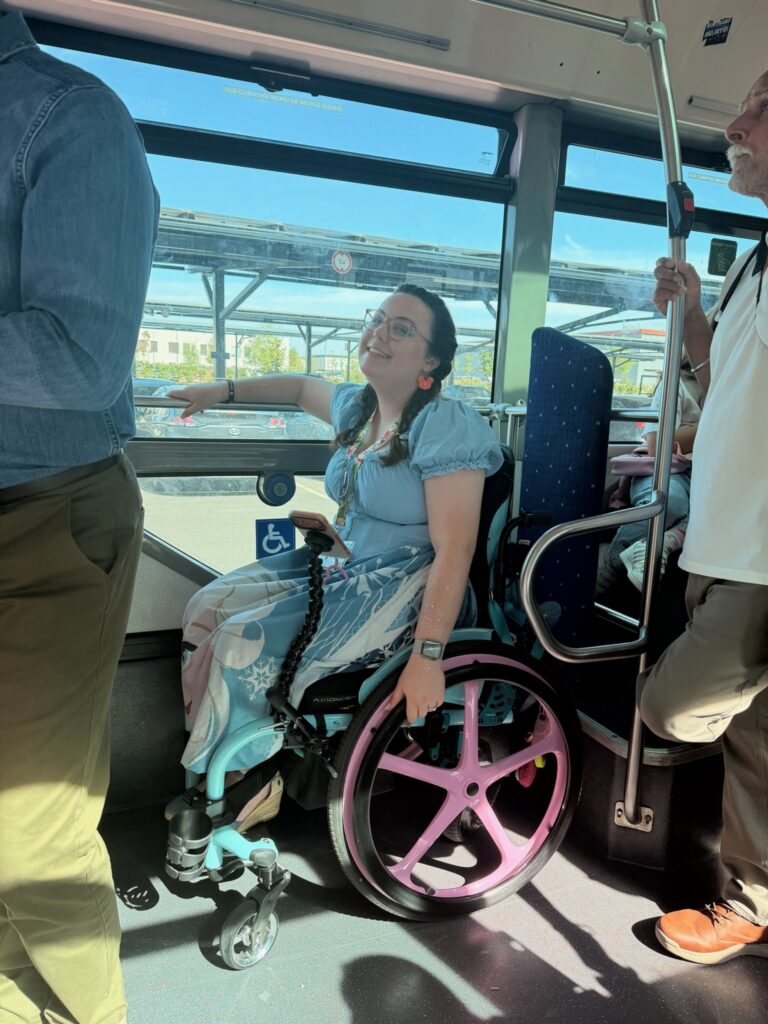
For context, on my latest trip I travelled by Eurostar and then connected onto the French rail network called InOui. The Eurostar portion itself was particularly reassuring because I was able to keep my wheelchair, medical supplies and emergency equipment with me throughout the journey, without the worry of essential mobility equipment being placed in an aircraft hold..
If you use a wheelchair, it’s worth reading Eurostar’s accessible travel information before booking. Eurostar says it has dedicated wheelchair spaces and can provide boarding assistance, while assistance for journeys where you need help should be requested in advance.
There’s also a useful money-saving detail that I only discovered afterwards. Your carer doesn’t automatically travel free, but Eurostar currently offers discounted companion fares for eligible travellers. For direct services to and from London, the published companion fare is currently £39 each way, and Eurostar says one companion fare can be booked alongside a wheelchair-user fare online when the companion is travelling with you for the whole journey.
Eurostar also explains its wheelchair booking process, including use of dedicated wheelchair spaces, ramps and boarding assistance.
If you’re doing what I did and changing onto another French rail service, remember that the onward connection is a separate part of the accessibility puzzle, so don’t assume Eurostar’s arrangements automatically carry across to the connecting operator.
Learn the Disneyland Paris app before day one
One of the biggest learning curves was understanding the Disneyland Paris app and virtual Character Encounter system. I got it wrong a couple of times at first and subsequently missed things on day one, but once I’d figured the system out I was able to compensate over the following days.
If Character Encounters matter to you, learn how they work soon after arriving – I’d suggest asking a cast member if you’re not sure. More generally, get familiar with the app before your holiday rather than downloading it as you’re walking through the gates. Knowing roughly where things are, how to see wait times and where your bookings or virtual queues appear removes another bit of unnecessary cognitive load from the day.
The other guests may be a bigger accessibility problem than Disney
I wish there were a delicate way of saying this, but the most inaccessible bit of Disneyland Paris was other people.
People walked into my wheelchair. People stepped across me. They fell on me. Crowds would form around me. People stood directly in front of me during entertainment and sometimes moving through busy areas became exhausting simply because other guests weren’t looking where they were going. Disney Magic apparently does not automatically produce spatial awareness.
This was particularly difficult around parades, because although Disney provides dedicated spaces for disabled guests and accompanying guests at outdoor shows and parades, you still need to plan ahead if getting a good view is important to you.
For the castle fireworks, we got into position around an hour and a half beforehand and ended up at the front of the accessible viewing area with an incredible view. That’s dedication, but it worked.
My biggest advice around parades is that if you arrive somewhere and discover a parade is about to pass, sometimes you’re better off simply staying where you are and watching it rather than trying to weave a mobility aid through thousands of people who are all looking at Mickey rather than where they’re putting their feet and if there’s a show or parade you desperately want to see, ask a Cast Member earlier in the day where the accessible viewing space is and when you should arrive.
Disneyland Paris somehow really works for my autistic brain
This is something I find fascinating because, objectively, Disneyland Paris sounds like somewhere my autistic brain should despise.
It’s busy. It’s bright. There is music everywhere. Thousands of people are moving in different directions. Characters appear. Parades materialise. Shops become crowded and fireworks explode over a castle and yet for me, Disney is incredibly relaxing.
I think part of that comes from the fact that Disney gives you permission to be enthusiastic in a way adult life rarely does. Nobody expects me to tone myself down there and I can wear as much glitter as I like, whilst blending in. At one point I literally lay on the floor in the Tangled area because my body needed a grounding moment.
I have photographic evidence.
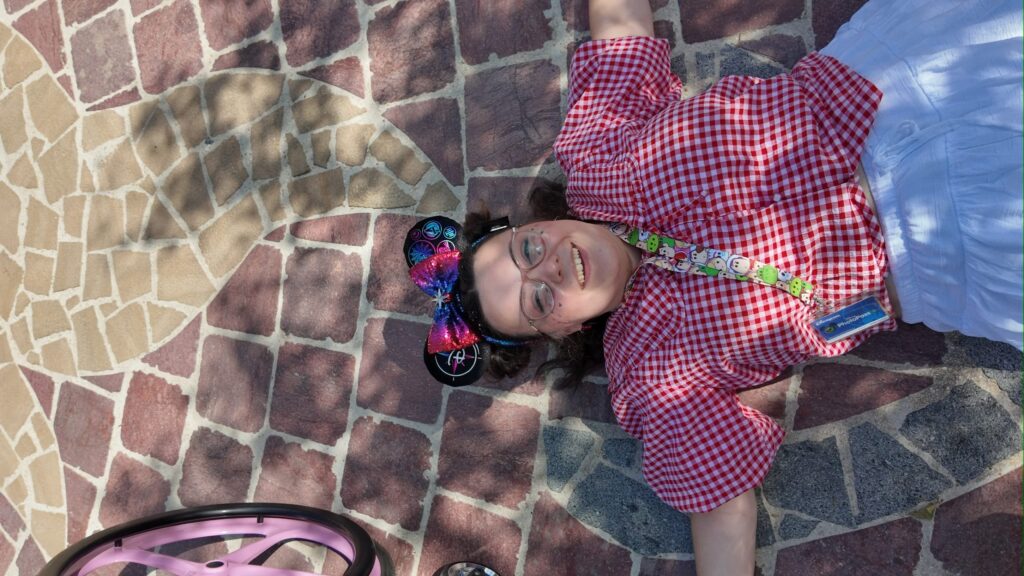
There absolutely were moments where the stimulation became too much. Parades could be loud and crowded, shops occasionally became overwhelming and other people’s behaviour during the fireworks could become distracting. Rather than forcing myself through those moments, I learnt to work with the natural peaks and flows of crowds.
If a shop was rammed, we’d come back later. If I needed shade, we’d find some. Ear defenders or other sensory aids are absolutely worth bringing if you use them.
For anyone specifically researching sensory or cognitive access, Disney’s current accessibility services include features such as noise-cancelling headphones, vibrating vests for some shows and a Blue Booklet for guests with cognitive disabilities, including Autism Spectrum Disorder. The current services are listed in Disneyland Paris’ official accessibility information.
Disney itself somehow creates a kind of stimulation that works for me because I don’t feel like I need to perform adulthood while I’m there. For me, that’s part of its magic.
Disney will not turn you into a morning person
I would like to formally apologise to pre-holiday Imali, who apparently believed that excitement about Disneyland Paris would fundamentally change decades of biology and suddenly make me get out of bed enthusiastically at 6am.
It did not.
Build your trip around the person you actually are, not the imaginary Disney version of yourself who’s apparently going to sleep perfectly, wake up at sunrise, eat a nutritionally balanced breakfast and arrive at the park gates looking like a princess.
If mornings are difficult because of medication, fatigue, pain or simply because you’re not a morning person, factor that in. Also, if you want to dress up, or do your hair or makeup, remember that will also take energy.
Your body can still crash even when your brain is having the time of its life
I learnt this almost immediately on my second trip.
I’d built the holiday up for so long, travelled to France, got everything sorted, finally relaxed and then on the morning of our first Disney day my bladder decided it was time to ruin everyone’s plans. For roughly the first three hours of day 1, I wasn’t in the parks – I was in fact at the hotel in horrendous pain.
Thankfully things gradually settled and I went on to have an incredible time, but it was an immediate reminder that Disney excitement doesn’t cancel chronic illness.
Sometimes I think we spend so much energy getting somewhere that our bodies wait until we finally relax and then everything catches up with us. Travel is a lot on your body, don’t underestimate it.
Did I subsequently go to bed as early as I should have every night? Obviously not.
I’m disabled, not sensible. Still, I like to think Disney Magic healed me.
This is exactly why I now desperately want a Disneyland Pass
The more I visit Disney, the more I think shorter and more frequent visits would actually suit my disabilities better than infrequent trips where I feel enormous pressure to squeeze everything into three days.
Disneyland Paris changes throughout the year. Different food appears, decorations change, seasonal shows arrive, the atmosphere shifts and suddenly there’s an entirely different version of the parks to experience.
I’ve only experienced Disneyland Paris during summer and I’m desperate to see it in winter. I’d have to approach things differently, particularly wheelchair warmth, blankets, clothing and standing around for evening entertainment in lower temperatures, but the idea of experiencing the faux snow makes me ridiculously happy.
The appeal of a Disneyland Pass for me isn’t simply “going to Disney loads”.
It’s removing the pressure to complete Disney every time I visit.
If I knew I could come back, I wouldn’t mind spending a shorter day there. I wouldn’t feel bad about sitting around Main Street for an hour. I could go specifically for a seasonal event, see what’s changed, eat something Mickey shaped, take some photos and go back to the hotel before my body stages a coup.
That’s a very different type of accessible holiday.
At the time of writing, Disneyland Paris offers eligible disabled guests a 25% reduction on the purchase price of a Disneyland Pass on presentation of valid accepted proof of disability at the Disneyland Park ticket counters. Disney also currently states that disabled Disneyland Pass holders need to register their intended visit dates in advance.
You can check the latest rules and discount directly on Disney’s official page for tickets and Disneyland Passes for Guests with disabilities.
If you purchase a Disneyland Pass, Disney also says you can request your Priority Card at the Disneyland Pass Office so that it is valid for the same validity period as your Pass. The current procedure is explained on the official Priority Card page.
Disney, again, if you’re reading this: hello.
So, is Disneyland Paris accessible for disabled visitors?
After two trips, I don’t think “Is Disneyland Paris accessible?” is quite the right question.
There is no such thing as somewhere being perfectly accessible to every disabled person because our disabilities, bodies, sensory requirements, communication needs and mobility are simply too different.
What I can say is that across my two visits, Disneyland Paris has genuinely impressed me with how much thought has gone into allowing disabled guests to participate in as much of the experience as possible.
Disney’s own accessibility guidance is very clear that access differs between experiences, and I’d always use that alongside lived-experience reviews like mine when planning your trip.
Not every attraction will work for every body. Not every day will go to plan. Sometimes a lift might be unavailable. Sometimes another guest will walk directly into your wheelchair while apparently looking everywhere except forwards.
But I’ve also encountered countless Cast Members who’ve listened, adapted, helped and treated my access requirements as ‘no big deal’ which is a breath of fresh air.
If you’re disabled and wondering whether Disneyland Paris is for you, I want you to know that you don’t need to experience Disney in exactly the same way as anybody else for it to be magical.
Learn what works for your body. Ask for the adjustments you’re entitled to. Research your specific access requirements rather than relying on somebody else’s definition of “accessible”. Bring more medical supplies than you think you’ll need for peace of mind, and significantly fewer hotel activities than I did. You won’t go wrong packing a power bank, something comfortable to wear and, obviously, proper British tea bags.
Most importantly, don’t spend your entire holiday racing towards the next attraction.
Some of my favourite memories from Disneyland Paris aren’t rides at all. They’re sitting somewhere beautiful with my friends, wandering around the shops looking at sparkly things, watching my friends experience seeing the castle for the first time, drinking peach tea in the shade, wearing princess ears and apparently lying on the floor in Rapunzel’s world.
This is your Disney holiday. Make the magic work for you. Because honestly, any day you get to meet the mouse is a pretty good day.
Useful official resources
Because accessibility arrangements, accepted documentation, ticket discounts and prices can change after an article is published, I’d recommend checking these official pages shortly before travelling: