 Skip to content








When I planned my latest trip from the UK to Disneyland Paris as a wheelchair user, travelling by train felt like the obvious accessible choice.
As a wheelchair user, I travel with a fair amount of stuff that isn’t particularly easy to replace, including my wheelchair itself, powered add-on, medication, stoma supplies and all of the other glamorous bits and pieces that come with taking a chronically ill body on holiday. The idea of putting essential mobility equipment into an aircraft hold and simply hoping everything would arrive safely at the other end didn’t exactly fill me with confidence, so being able to travel with everything alongside me gave me a huge amount of peace of mind before we’d even left London.
There’s also the luggage aspect. Travelling disabled rarely lends itself particularly well to minimalist packing, and travelling by train gave me more flexibility around everything I needed to bring with me. Having now done the journey, though, I think it’s important to separate my experience into two parts because they were incredibly different. Eurostar itself was brilliant, whilst changing at Lille and continuing through the French rail network was considerably more challenging.
That distinction matters because although you can currently book London to Disneyland Paris as one journey through Eurostar, the route involves travelling from London St Pancras to Lille Europe before changing onto a French TGV service to Marne-la-Vallée Chessy, which is directly outside Disneyland Paris. Many years ago there used to be one direct train, but sadly it doesn’t run anymore at this time.
On paper, you’re booking one journey through Eurostar. From an accessibility perspective, there’s at least four parts where you need Passenger Assistance.
Why Eurostar gave me peace of mind as a wheelchair user
Probably the biggest advantage of travelling by Eurostar was simply knowing where my mobility equipment was. With a wheelchair, damage or loss isn’t equivalent to an airline temporarily misplacing a suitcase. My chair is part of how I’m able to navigate the holiday I’ve spent months planning in the first place, so knowing it was travelling alongside me removed an entire category of anxiety. The same applied to my medical supplies because everything I relied on was with me, accessible and under my control rather than disappearing somewhere I couldn’t reach it.
That might sound like a minor thing if you’ve never travelled with essential medical or mobility equipment, but it’s a feeling I know many disabled travellers will understand. Sometimes accessibility isn’t about somebody actively doing something for you, it’s simply removing one of the things you’ve become accustomed to worrying about. Especially on your first few trips outside of the UK…
Passenger Assistance at St Pancras
I arranged Passenger Assistance in advance and found the Eurostar part of the process incredibly straightforward. Eurostar currently asks disabled passengers requiring a wheelchair space and ramp assistance to arrange it with them at least 24 hours before travelling, and its guidance says wheelchair spaces are positioned close to accessible toilets. It also recommends arriving at least 75 minutes before departure for wheelchair bookings on London routes – I was slightly later than this due to London crowds, but everything was ok.
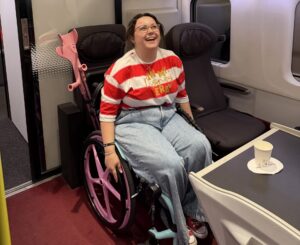
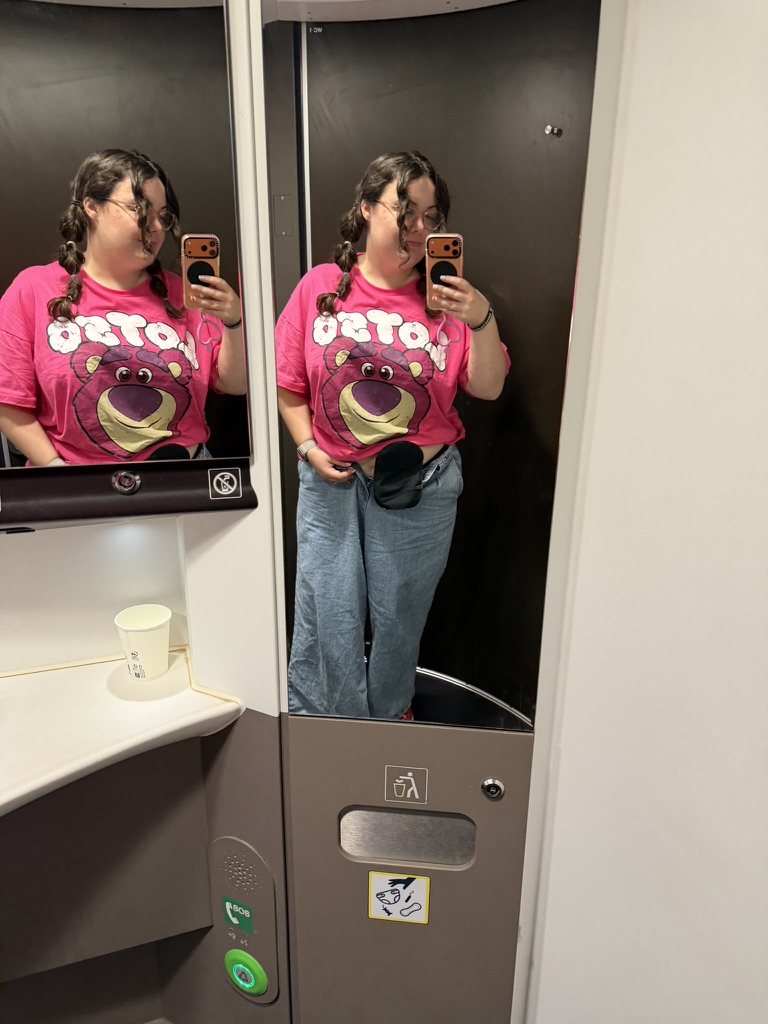
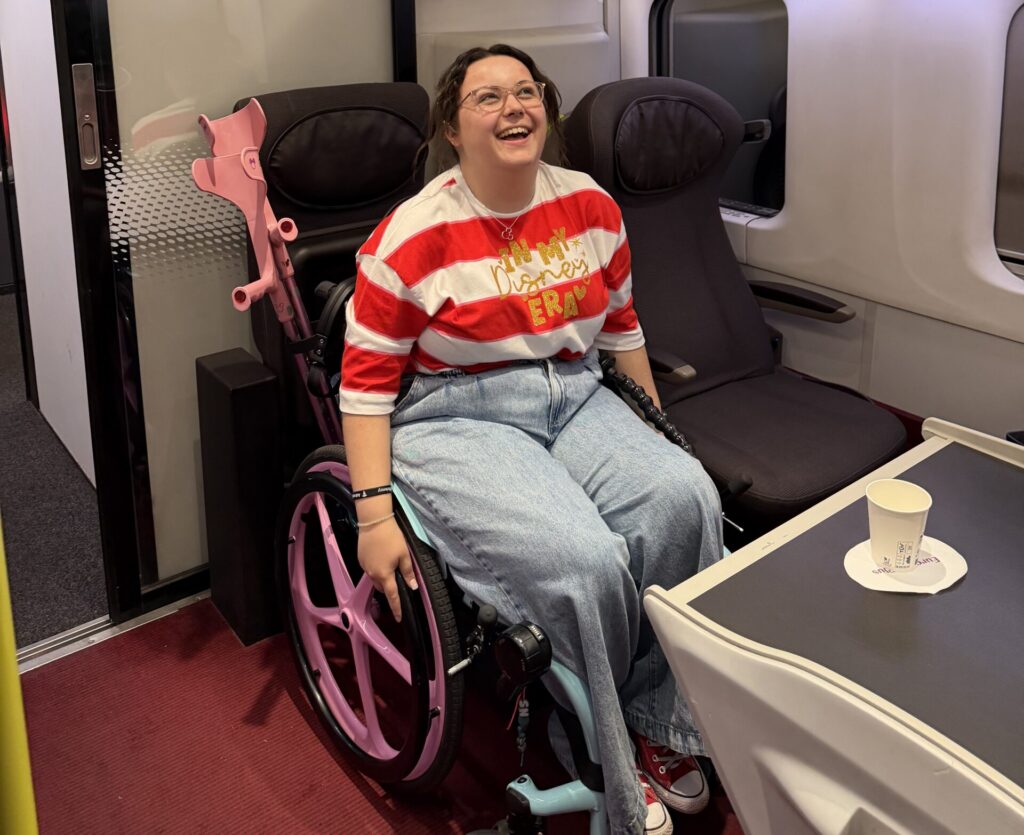
Once we were there, the staff helped me board using the ramp, made sure I was settled and positioned me near the accessible toilet, which as somebody travelling with a stoma gave me enormous peace of mind. I also absolutely loved the accessible table around my wheelchair space because rather than expecting me to somehow make a conventional fixed table work around my chair, it essentially extended around me and gave me a genuinely comfortable setup from the beginning of the journey.
It’s exactly the kind of accessible design I love because it doesn’t feel like an elaborate special arrangement. It just works really well and now I know for next time that I’ll be comfortable.
We got to use the passenger lounge with Eurostar before leaving, and I can tell you that having somewhere comfortable to wait and a grab a drink before travelling really helped. I knew there were toilet facilities nearby, drinks on demand and I had all of my luggage with me. I wasn’t starting the holiday overstimulated, flustered or already physically exhausted before I’d even made it to France, and when you live with multiple health conditions, that’s a much bigger accessibility win than it might initially sound.
What was Eurostar actually like onboard?
Once we were moving, the journey itself was honestly really comfortable. I had deliberately worn something I knew I’d be happy travelling in, my luggage remained nearby, the accessible toilet was close and the staff checked in on us during the journey without feeling intrusive. Drinks were available and, naturally, I managed to acquire a cup of tea.
I didn’t eat the food offered because my particular allergies fall outside the main allergens I could identify from the available information and, combined with having a stoma, I wasn’t particularly interested in experimenting while travelling. If you’re somebody with more complicated dietary requirements like me, I’d look at what’s available before travelling and think about what appropriate food you might be able to take with you under the current border rules rather than simply assuming you’ll definitely find something suitable onboard.
Overall, though, my biggest memory of the Eurostar portion of the journey is that I felt calm. I wasn’t worrying about where my wheelchair was and I wasn’t stressing about whether I’d be able to access a toilet if I needed one. I could sit there with my cup of tea, chat with my carer and think about the fact that I was going to Disney!
And then we arrived at Lille
This was where the experience changed quite significantly. Because there currently isn’t a direct London Eurostar service to Disneyland Paris, our journey required us to change at Lille Europe and continue onwards on a French high-speed TGV service to Marne-la-Vallée Chessy. The final station is amazingly convenient because you essentially arrive at Disneyland Paris itself, so it wasn’t the destination that caused the difficulty. It was the process of moving between two different rail and assistance systems.
On our outbound journey we had around an hour at Lille, so I didn’t feel particularly worried about the time. What immediately concerned me was that the assistance experience felt noticeably different from what we’d just experienced with Eurostar. While we were waiting, another wheelchair user very nearly came off a boarding ramp after it hadn’t been properly secured in front of us, and watching that happen naturally affected my confidence in the people who were then about to help me board.
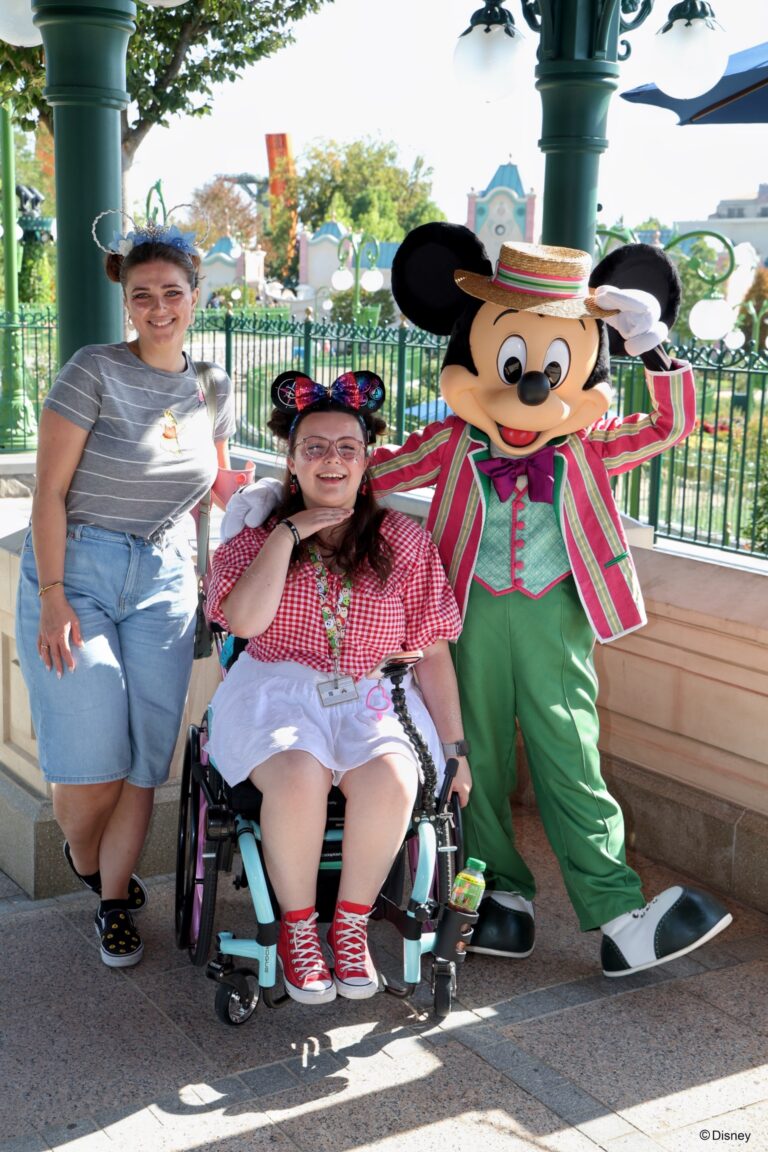
Communication was also more difficult due to the language barrier and the TGV itself felt considerably more cramped as a wheelchair user (my lap table was quite literally bent up into me the whole of the 1.5 hour journey). We managed it, nothing catastrophic happened to me and we eventually got to Disney, but by the time we arrived I was more than ready to see Mickey.
The return journey was where the change became a much bigger problem
Coming home showed me why connections can create such a significant accessibility vulnerability because our TGV from Disneyland Paris was heavily delayed. A delay on a direct train means you arrive late, which is annoying, but a delay when you’re making a connection means the carefully planned transfer window you’ve relied on begins disappearing while you’re still sitting on the first train.
By the time we arrived at Lille, the buffer we’d expected had essentially gone, so suddenly we were trying to move me, my wheelchair, powered add-on, luggage and carer through the Customs border and onto a waiting Eurostar as quickly as possible. That’s already quite a lot to manage when you’re disabled, and things became even more stressful when there was confusion during the border process around my wheelchair and powered add-on.
I ended up temporarily separated from my carer for thirty minutes while staff worked out how my equipment needed to be processed, communication became difficult and at one stage I had to remove my hearing aids while all of this was happening due to security rules. Written down individually, none of those things necessarily sounds enormous, but that’s one of the things I think can be misunderstood about disabled travel: barriers accumulate.
By then we’d already had the delayed train, lost our connection time, were managing luggage and medical needs and were trying to navigate an unfamiliar border process. Add being separated from the person supporting me and trying to explain mobility equipment under time pressure, and both of us were understandably overwhelmed.
Eurostar holding the train made an enormous difference
We didn’t know until we got down to the platform, but it turns out that Eurostar held the train for us, to ensure that we could make it through customs in time. This was wild, as we were very late – but oh so grateful to be boarded.
Without their decision, the situation could have become considerably more complicated. My experience with Eurostar itself was overwhelmingly positive; the accessibility challenges arose during the transfer between separate systems and operators, and those are two very different things.
I think it’s important when talking about accessibility to be specific about where systems work as well as where they fail. Otherwise businesses that have actually got things right don’t learn what disabled people value, while the parts creating the barriers can hide inside a general complaint.
Accessibility only works when the whole journey connects
The biggest thing this trip reinforced for me is that accessibility doesn’t exist in isolated moments. You can provide me with a brilliant wheelchair space on one train, but if the people transferring me onto another service don’t understand the equipment, the overall journey still becomes inaccessible. You can provide excellent Passenger Assistance in London, but if the next assistance system works completely differently and the information doesn’t carry across, the disabled passenger is the one left trying to bridge the gap in a second language.
Disabled travellers experience the whole journey and it’s exhausting enough to manage ourselves during unfamiliar activities, let alone everything else around us.
That’s why I think accessibility needs to be considered much more collaboratively across transport systems. The accessible journey isn’t finished because one operator successfully helped me onto their train. It’s finished when I reach the place I’ve actually booked the journey to.
One thing I wish I’d known about Eurostar wheelchair and companion fares
Something I only properly learnt after travelling is that Eurostar currently offers specific wheelchair-user fares and discounted companion fares. On direct Eurostar services to and from London, the wheelchair-user fare is currently £39 each way, with eligible wheelchair users travelling in Eurostar Plus or Eurostar Premier at the fixed price and conditions of a Standard ticket.
If you’re travelling with somebody who’s supporting you, an eligible companion travelling alongside a wheelchair user can also currently access Eurostar’s £39 each-way companion fare on direct London services, provided they accompany the wheelchair user for the whole Eurostar journey.
I wish I’d known this before travelling as I could’ve saved some money, so it’s worth checking the current Eurostar wheelchair-user fares and Eurostar companion fares before you book because prices and eligibility can change.
Would I travel to Disneyland Paris using Eurostar again?
Yes, absolutely. In fact, I’d happily use Eurostar again because the actual Eurostar sections of the trip were some of the more comfortable international travel I’ve experienced as a wheelchair user. The staff were friendly, the boarding arrangements made sense, I could keep my wheelchair and medical supplies with me, I had accessible toilet facilities nearby and I arrived without feeling as though the train itself had unnecessarily consumed all of my energy.
The bit I’d hesitate over isn’t Eurostar, it’s the change at Lille. I’d still do it because the journey ultimately got me to Disneyland Paris, but I’d go into it understanding much more clearly that the onward assistance arrangements may not feel the same and that any delay can have much bigger consequences when you’ve got an international connection waiting at the other end.
Please bring back the direct London to Disneyland Paris train
This is perhaps the most frustrating part because direct Disneyland Paris rail connections do still exist from parts of continental Europe. Eurostar currently operates direct connections to Marne-la-Vallée Chessy from locations including Brussels, Antwerp, Amsterdam, Schiphol and Rotterdam, while it confirms that its direct London to Disneyland Paris service is not currently running.
For London travellers, bringing that service back would remove an enormous accessibility barrier in one move. There’d be no Lille transfer, no change of train, no handover between different assistance systems and considerably less risk that a delay on one part of the journey destroys the connection to another.
Sometimes the best accessibility adjustment isn’t another form, ramp or special service designed exclusively for disabled people. Sometimes it’s simply removing an unnecessary barrier for everybody.
Until then, I would still recommend exploring Eurostar as an option based on the experience I had. Just go into the Lille connection prepared and remember that booking a through journey doesn’t necessarily mean every stage of the accessibility experience will feel connected.
Accessible travel isn’t simply about whether person with a disability can physically get onto a train. It’s about whether the person using it can get from their front door to their destination safely, comfortably and with enough energy left to enjoy whatever they’ve travelled all that way to do.
In my case, it was Disneyland Paris and after all that, I was extremely ready for a little Disney Magic.
Useful official information
Travel arrangements and accessibility services can change, so check the latest information before booking:
- Eurostar: London to Disneyland Paris via Lille
- Eurostar accessible travel information
- Eurostar wheelchair booking information
- Eurostar wheelchair-user fares
- Eurostar companion fares
Read next: Disneyland Paris Accessibility as a Disabled Visitor: What I Wish I’d Known Before I Went
Also useful: The Ultimate Disneyland Paris Packing List for Disabled Travellers